Movies Run on Subtext. So Do Companies. AI Is About to Read It All.
What coding agents and screenwriting teach us about the company of the future
As an FDE I get to work with coding agents all day which keeps me caught up on the latest trends and more in GenAI. It is interesting to see how trends in agentic coding evolve and one that struck me is sharing intent with the coding agent: why you're building something, what problem it solves, and what good looks like, so the agent can make good calls when it hits something you didn't anticipate.
The difference shows up fast. Ask an agent to "make the Buy button bigger" and it will do exactly that, even if size was never the problem. Tell it instead, "shoppers on phones are abandoning their carts, and we think they can't find the Buy button; it should be easy to spot and tap," and it can find the real cause (maybe a pop-up is covering the button), adapt when the page isn't what you pictured, and check its own work against the goal.
Underneath every good session is a loop:
- Bet. We think this change will improve something (a "bet" in the sense of Annie Duke’s Thinking in Bets).
- Intent. We explain why: the problem, and why we believe this will help.
- Action. The agent makes dozens of small decisions we never specified.
- Judge the result. Did it do what we intended?
- Judge the bet. Did doing it actually pay off?
Watching developers learn to hand over intent, I noticed two things. Most people at work never get the same treatment: they're handed tickets and workflows with the reasoning stripped out (Agile to the rescue—if you actually achieve Agile). And the habit itself reminded me of how screenwriters are taught to break down a scene. Robert McKee has writers look at every beat on two levels: what a character seems to be doing on the surface, and what they're actually trying to achieve underneath—intent. In Dialogue, he writes that beneath every line of character talk there must be "a desire, intent, and action."
Take that idea from a single scene up to a company like Netflix, and it leads somewhere interesting: a company where every bet—every intent—is written down so agents can act on it, where a surprising amount of today's work turns out to have no stated purpose at all, and where people matter most as the ones who choose which bets to make.
Why we fail to make intent explicit
So why don't we share intent for everything? Watch a developer for a day and you'll see.
For the checkout bottleneck, the engineer does the hard thinking: the problem, the hypothesis, the proposal, how we'll measure the outcome. Then they get to the settings page. They're tired. Writing a hypothesis for a profile form feels absurd. So they type: "Just build a clean settings page."
The agent doesn't stop. It fills the gap with what it knows, averaging the thousands of settings pages in its training data into something reasonable. A little back-and-forth, and it ships.
That's fine for a settings page. The trouble is that people do exactly the same thing. Hand someone a goal with no intent attached ("improve enterprise retention," "refresh the Q3 campaign") and they fill the gap from their own training data. They copy the playbook from their last company. They follow a workflow whose original purpose nobody remembers. They iterate through status meetings until the boss nods.
Most companies believe they're making strategic bets. A lot of their daily motion is pattern matching on autopilot. AI is about to make that painfully obvious, because an agent can do the same pattern matching in ten seconds for pennies.
| Intent not stated | Intent stated | |
|---|---|---|
| High stakes | The danger zone: "improve enterprise retention," the playbook copied from the last company, the workflow nobody can explain | Explicit bets: the checkout bottleneck, the Buy button on phones |
| Low stakes | Pattern matching on purpose: the settings page | Over-specified: effort that buys nothing |
Breaking down a scene in a screenplay
Screenwriting has a useful habit here. When a good script reader gives notes on a scene, they don't start by rewriting the dialogue. They ask what the scene was for: what had to change for the character, did that come across on the page, and does it move the whole story forward?
McKee turns that question into a method. In Story, once you know what a scene is for, you break it into beats, single exchanges of action and reaction, and label each beat twice: what the character seems to be doing on the surface, and what they're actually doing underneath. The second label has to be an active verb, like begging.
Here's what that might look like for our diner scene:
| Beat | Who | On the surface | Underneath |
|---|---|---|---|
| 1 | Older brother | Asks how Dad is doing | Testing whether his brother still cares |
| 2 | Younger brother | Talks about how busy work has been | Deflecting |
| 3 | Older brother | Mentions Dad's empty workshop | Pulling him back home |
| 4 | Younger brother | Laughs and asks for the check | Shutting him out |
Read only the third column and you have small talk. Read the fourth and you have the scene. McKee's point in Dialogue is that talk on the page is really action: every line is a move a character makes to get what they want. Writers who put down only the surface produce what the industry calls on-the-nose dialogue, lines that mean exactly what they say. Good dialogue, McKee writes, "puts a subtext under every text."
Aaron Sorkin describes the same engine as intention and obstacle: somebody wants something, and something is standing in their way. Different teachers, same conclusion. The words on the page are the instructions; the intent underneath is what makes the scene work. It's the same split as "make the Buy button bigger" and "stop losing shoppers on their phones."
Write that intent down for a whole scene and you have an intent key. It maps neatly onto what we hand a good agent:
- The problem. The friction in the story this scene has to resolve.
- The hypothesis. Why resolving it here will make the larger act land.
- The proposal. The setup: two brothers arguing in a loud diner. A starting point, not a fixed spec.
- The expected outcome. What the audience must feel by the final line. This is how we'll judge whether the bet worked.
In practice, nobody hands a reader a ledger of scene-by-scene intents. We infer intent backward from the finished pages. More often, the writer never worked it out at all. They wrote the scene because a line of dialogue sounded good, and hoped it would hold together. Seen through the lens of an agent, that's a vague prompt tossed over the wall.
8 PM at Netflix
Now zoom out. Netflix isn't in the business of writing one screenplay. At 8 PM on a weeknight it is trying to hold the attention of millions of tired viewers, minute by minute. That is itself a stand-in for the bet that matters more: that those households are still subscribed next month.
Our diner scene now sits inside several bets at once. The writer's bet is that it deepens the brothers. The service's bet is that the viewer is still watching at minute twelve. And suppose the partnerships team has placed a luxury watch in the scene to hit a sponsorship quota. That's a third bet, judged by whether the watch was seen.
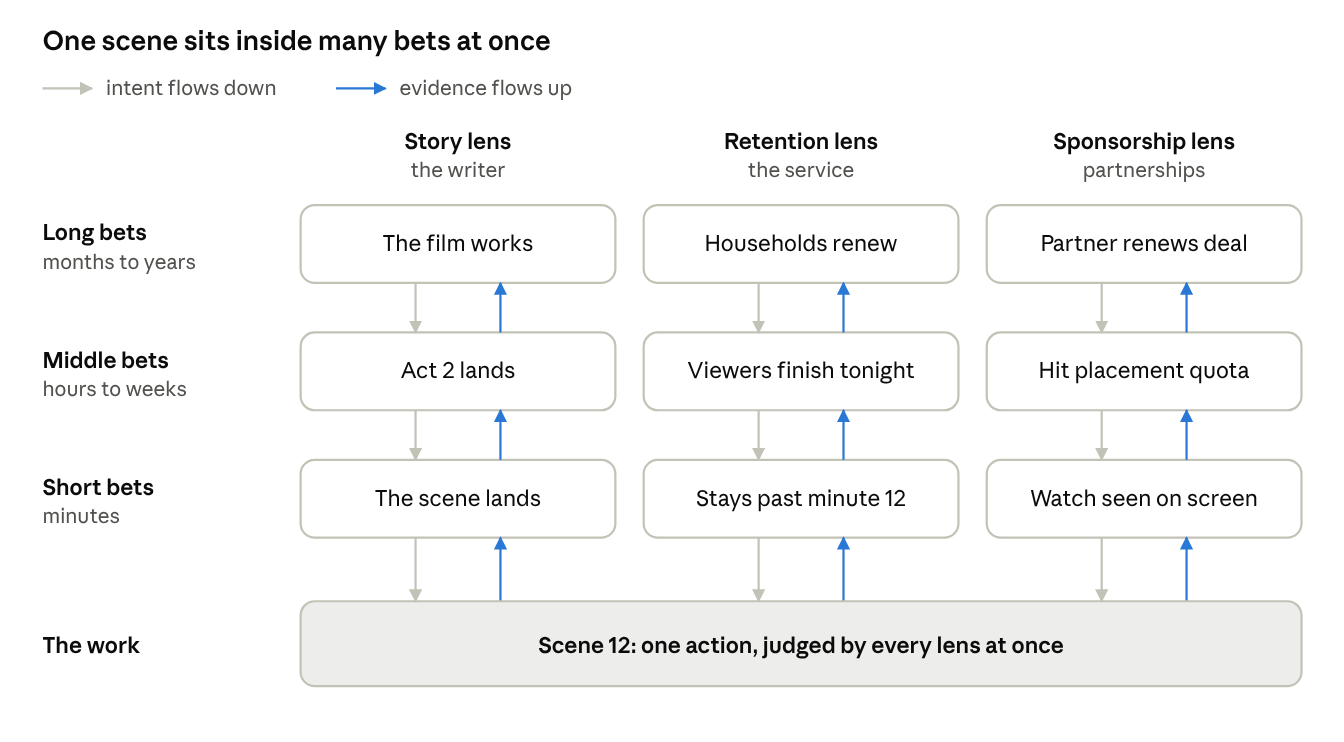
So a company isn't a tidy tree of bets. Read down any column and each shorter bet stands in for a longer one. Read across and different teams judge the same piece of work, by different measures, at the same moment. It's a web.
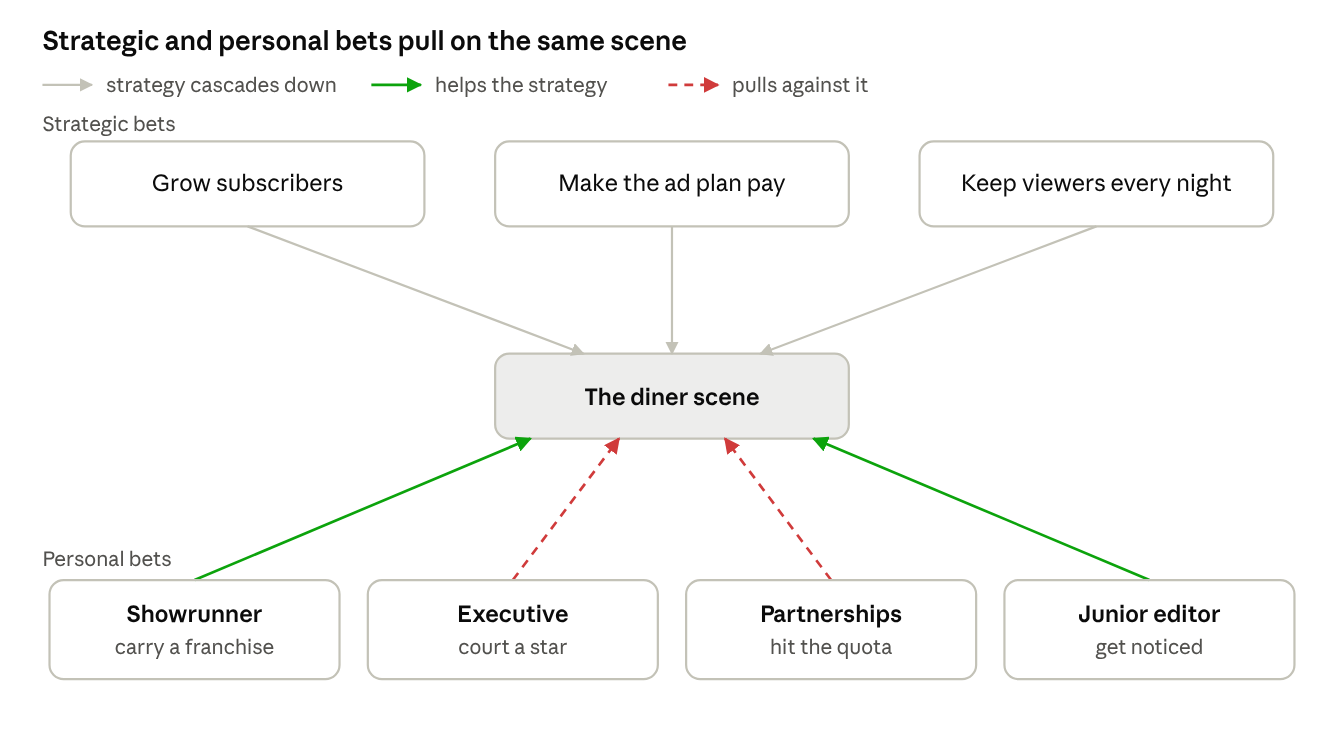
And that's only the bets someone drew on a slide. Above the scene sit Netflix's strategic bets: grow subscribers, make the ad-supported plan pay, keep people coming back every night. Each one cascades down through slates, seasons and episodes, and each eventually lands on the same diner scene. Sometimes they pull together. Sometimes they don't: the moment that keeps viewers on the edge of their seats may be exactly the wrong place for an ad break.
Then add the people. Picture everyone who touches that scene, each placing bets of their own. The showrunner is betting this season proves they can carry a franchise. An executive is betting a subplot will win over a star they want for the next project. The partnerships team is betting on making its quota. A junior editor is betting a bold cut will get them noticed. Some of these bets line up with the strategy. Some quietly work against it. Almost none of them are written down.
Layer all of that together and you don't get a tidy matrix. You get a tangle: thousands of bets, strategic and personal, long and short, all pulling on the same piece of work at the same moment.
Where the gaps are
Why is that tangle so hard to read today? Because every bet in it leaves gaps, and something always fills them. The gaps come in three kinds.
Gaps nobody can close. Did the viewer leave during Scene 24 because of the scene, or because it was 11 PM and they had work in the morning? Nobody can fully untangle that. Some uncertainty is simply part of the world. The honest response is to manage it: hedge, keep options open, and run shorter loops so you learn sooner.
Gaps we leave ourselves. Now suppose the writer of Scene 24 never worked out what it was for. No problem, no hypothesis, no expected outcome, just a line of dialogue that sounded good. That gap isn't the world's fault; it's ours. Some of these gaps are fine to leave open on purpose, like the settings page. The trouble is the ones nobody chose, on bets that matter.
Gaps in the evidence. Even a bet that's written down gets judged on evidence, and evidence can mislead in three ways. The measurement can be off: a survey of a few hundred viewers who don't say what they really think. The attribution can be off: viewers stayed past minute twelve, but for reasons that had nothing to do with the scene. And the proxy itself can be off: we watch minute twelve because we believe it leads to renewals, and that belief is a bet too. A loop can be explicit, measurable and still wrong.
The intent log
Now run the thought experiment. Imagine a future Netflix where every bet in that tangle is written down with its intent key attached, at every level where evidence can be gathered, so that agents and people can reason across all of them. Pull back the covers. What would you see?
The gaps would show. Suppose that at 8:14 PM, telemetry catches a six-percent drop in viewers during Scene 24. An evaluation agent goes to check whether the scene's hypothesis failed, and finds there was no hypothesis. The log files an incident report: an unexamined hunch cost us viewers.
The strategic bets would show for what they are. Some sound, some wrong, and some long expired, still running because nobody ever turned them off.
And the personal bets would show. This is where it gets uncomfortable. Nobody is going to write "I'm pushing this subplot to win over a star before my promotion review." They don't have to. When every change needs an intent key tied to the bet above it, personal bets surface on their own: as work that can't be tied to any strategic bet, or as trade-offs someone now has to state out loud. We are betting that $500k in placement revenue outweighs a projected 1.2% drop-off in viewers. Maybe it does. Now someone can actually decide.
Not every personal bet is self-serving, either. Some are careers, hunches or learning. Some are deliberate hedges against a strategy that might be wrong; Slack started as an internal tool at a games company. The difference between a hedge and a hidden agenda is that a hedge is declared.
That changes how you see a company. The railway didn't just move freight faster. It forced companies to invent timetables, org charts and cost accounting, and it changed how people pictured work fitting together. An intent log does something similar. The org chart tells you who reports to whom. The log tells you what everyone is actually betting on.
Writing it down doesn't make it right
It would be easy to read this as a call for a perfectly planned company. It isn't. Writing a bet down makes it visible. It doesn't make it right.
Take a coin toss. It looks like pure chance, but it's physics: a tossed coin lands slightly more often on the side it started on (Diaconis, Holmes and Montgomery, 2007). In 2023, a team of researchers put that prediction to the test with 350,757 real flips. Coins landed on their starting side about 50.8% of the time (Bartoš et al., 2025). Measure enough and some of the "luck" becomes predictable. Never all of it, though. Tiny differences in how a coin leaves your thumb grow until prediction fails. Better information shrinks luck; it never removes it.
Movies sit at the far end of that spectrum. Screenwriter William Goldman famously said that in Hollywood "nobody knows anything," and economists later showed he was right in a precise sense. Box-office returns are so heavy-tailed that there is no typical movie, and forecasts have essentially no precision (De Vany and Walls, 1999).
So where do humans fit in, who green-lights the movie?
Which brings us to a question anyone can relate to. If nobody can know which film will be a hit, who should make the call: a person or an AI?
It's tempting to think that handing the decision to AI is like flipping a coin. It isn't. An AI builds a case from what has worked before. When researchers asked AI models to evaluate strategic options, single evaluations were inconsistent and biased, even by the order the options were shown in. Averaged across many runs, though, they came to resemble expert rankings (Doshi, Bell, Mirzayev and Vanneste, 2025). In other words, at its best, AI gives you the consensus view.
In a business where the hits live far out in the tail, the consensus view is exactly where the big wins aren't. And if every studio asks similar models, every studio makes similar bets. When many decision-makers rely on the same algorithm, the overall quality of their decisions can fall, even if the algorithm beats each of them on their own (Kleinberg and Raghavan, 2021). In one experiment, writers given AI ideas wrote better stories, and the stories were more alike (Doshi and Hauser, 2024).
So the case for a human at the top isn't that people predict better. Nobody predicts this well. It's that someone has to own the pick, the pick should carry a real point of view, and it should come from somewhere other than the model everyone else is consulting. The same holds well beyond film: for any big bet where nobody can know the outcome, someone has to choose and stand behind it.
The hybrid studio
Does this mean people will spend their days writing intent keys for every line of dialogue and every button on a screen? No.
In software, the early fear that AI would replace developers is giving way to a different picture: people steering fleets of agents. As Rob West argues in The Agentic Software Factory Is the Wrong Metaphor, cheap execution doesn't turn creative work into an assembly line. It moves the bottleneck to deciding what's worth building and judging whether it worked.
Now imagine a hybrid studio. People author the high-level intent: the concept, the logline, the act structure, the crucial turns. They own those bets. Agents cascade them into scene-level intent, draft the beats, test the results against the evidence, and loop. And some work goes to agents almost entirely: the ten-second transition that gets a character from a cab into an office, the alternate cuts of a trailer, the recap at the top of an episode, maybe even whole low-stakes productions. Nobody writes an intent key for those. We let the agents pattern-match, on purpose.
If that sounds familiar, it's because it mirrors what is already happening in software. The settings page, the internal admin tool, the routine bug fix: work that used to go to junior engineers increasingly goes straight to an agent, while senior people spend their time on the intent behind the work that matters most. Both industries now face the same open question. Junior work was also how people learned to become senior. If agents take it over, we'll need another way to grow the people who write the intent keys.
A web of bets
Agents may not change what ends up on your screen. They will change everything underneath it.
They take over the pattern matching that used to pass for strategy, and they make writing intent down cheap. What's left is a new picture of a company. It stops being an org chart of people running workflows and becomes a web of explicit bets, where you can finally see which work is habit, which is a hidden agenda, which is a declared hedge, and where people are placing real bets on the future.